
Superyacht Charter Cost by Size: $30K vs. $50K vs. $100K/Week
At the same price, a catamaran carries more cabins than a motor yacht nearly twice its length. See what $30K, $50K and $100K actually buy: by hull type, from real charter rates.
Last Updated: September 7, 2026
How much a superyacht charter costs per week depends less on raw length than most guides admit. It tracks how many cabins and guests the yacht sleeps, and that’s where catamarans and motor yachts split hard. A catamaran packs more cabins, beam, and deck space into every foot of length, so a 56 ft catamaran sleeps the same eight guests as a 94 ft motor yacht. Compare them by length alone and you’ll badly misjudge what your budget actually buys.
We analyzed 550 crewed yachts holding a bookable 2026-27 Caribbean or Bahamas rate to map exactly what $30K, $50K, and $100K per week gets you, broken out by catamaran versus motor yacht, not just by length. If you’re new to how charter pricing works, start there for the basics on base rates, APA, and add-on fees. You can also drop any of these price points into the yacht search on our homepage to pull up real crewed yachts available in your range right now.
Key Findings
Across the 550 crewed yachts holding a bookable 2026-27 Caribbean or Bahamas rate, hull type, not length, was the single biggest predictor of how much usable space a charter price actually buys. Catamarans account for 353 of them (64%), motor yachts 174 (32%) and sailing monohulls 23 (4%), and the hulls follow completely different cost curves (Vital Charters rate analysis, September 2026).
- A catamaran sleeps 8 guests in 4 cabins at 56 ft; a motor yacht needs 94 ft for the same eight. Measured on the 220 yachts carrying exactly 4 guest cabins and 8 berths: catamarans reach that layout at a median 56 ft (167 boats), motor yachts at 94 ft (53 boats). Beam and one wide living deck do the work that 38 extra feet of hull does on a monohull.
- At the same length, a catamaran sleeps a third more. In the 45-55 ft band, catamarans carry a median 8 guests across 4 cabins (160 boats); the few motor yachts that short carry 6 guests across 3 (6 boats). Motor yachts barely compete at this length: only 11 in the whole fleet measure under 65 ft.
- Catamarans deliver 1.38 guests per 10 ft of length against 0.85 for motor yachts: roughly 1.6× the sleeping capacity per foot.
- To sleep 8 guests in 4 cabins, the median catamaran lists at $33,000 a week and the median motor yacht at $60,000. Same headcount, nearly double the rate, and that is before the motor yacht’s APA is added: you’re paying for the extra length a monohull needs to hit those cabin counts.
- 88% of catamarans charter all-inclusive; 95% of motor yachts charter “plus expenses.” That single difference changes your true cost more than any amenity: the catamaran rate is usually the number, while the motor yacht rate is the base before APA and gratuity.
- Cost per guest is not flat across size: it more than triples. A 45-49 ft catamaran lands at about $513 per guest per night; an 80-99 ft catamaran at $1,910. Cabins do not scale with length as fast as price does, so a longer boat costs more per head, not less.
- The global yacht charter market reached $9.30 billion in 2025, projected to hit $12.69 billion by 2031 at a 5.32% CAGR (Mordor Intelligence, 2026): and the entry tier is where most new charterers now start.
Why Length Isn’t Space: The Catamaran vs. Motor Yacht Math
A catamaran’s two hulls and the wide bridgedeck between them give it a beam roughly half its length, so a 50ft catamaran can carry a salon, galley, and cockpit wider than a 90ft motor yacht’s main deck (Vital Charters rate analysis, September 2026). That’s why comparing charters by length alone is the most common mistake first-time clients make, and the reason this guide splits every price tier by hull type.
Here’s the head-to-head from current listings. The numbers are medians across every catamaran and motor yacht we currently list:

View data table
| Hull type | Median length to sleep 8 guests in 4 cabins | Yachts in that layout | Guests per 10 ft (median) |
|---|---|---|---|
| Catamaran | 56 ft | 167 | 1.38 |
| Motor yacht | 94 ft | 53 | 0.85 |
| Sailing monohull | Too few to publish (3) | 3 | 0.77 |
Source: Vital Charters rate analysis of 550 crewed yachts, September 2026.
The takeaway isn’t “catamarans are better.” It’s that the two hull types deliver value differently, and your budget buys very different boats depending on which you choose:
- A catamaran spends your money on cabins, beam, deck space, stability, and shallow draft (ideal for the Bahamas’ thin water). Most charter all-inclusive, so the rate is close to your real cost.
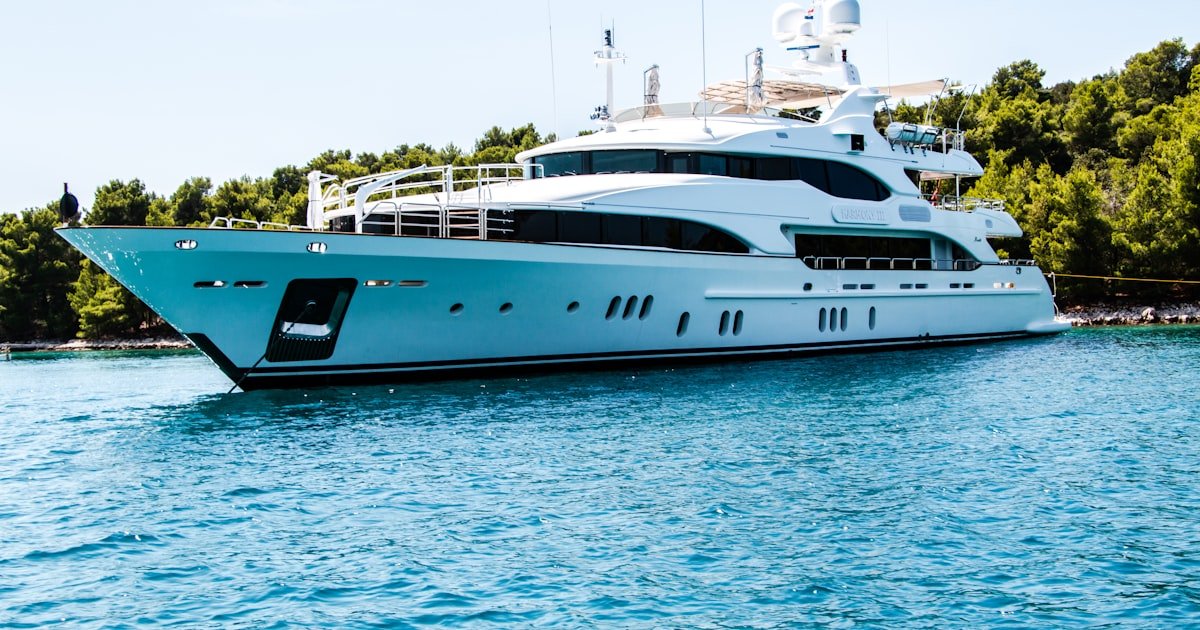
- A motor yacht spends your money on length, speed between islands, multiple decks, larger air-conditioned interiors, bigger crews, and toy garages. Most charter “plus expenses,” so APA and gratuity stack 50–55% on top of the base rate.
Want the deeper comparison of how the hulls themselves differ underway? See our guide to sailing catamarans vs. power catamarans.
How We Analyzed Charter Pricing
We pulled live specs and weekly rates from 550 crewed yachts holding a bookable 2026-27 Caribbean or Bahamas rate, every vessel with complete length, cabin, guest, and rate data, then segmented by hull type, length band, and price band. This isn’t a blended market estimate; it’s what real boats actually rent for right now (Vital Charters rate analysis, September 2026). APA is read from each rate’s own contract terms where the listing states one and imputed by cruising region where it does not; gratuity conventions follow MYBA guidance.
Sample Parameters
| Parameter | Value |
|---|---|
| Yachts analyzed | 550 crewed charter yachts holding a bookable 2026-27 rate |
| Hull types | Catamarans (353), motor yachts (174), sailing monohulls (23) |
| Regions covered | Caribbean and Bahamas |
| Data captured | Length, cabins, max guests, builder, year, weekly rate, pricing model |
| Exclusions | Bareboat charters, day charters, listings missing core specs, seasons that end before September 2026, and rates that price a Mediterranean or US season rather than a Caribbean one |
Limitations
- Listed rates, not promotional ones: These are published rate cards. Separately from them, 67 yachts across the Caribbean and Bahamas were carrying a live promotional offer when we pulled this on 7 September 2026, a median 10% off, most of them naming shoulder-season or summer weeks. Those offers change from week to week and are not in the figures below.
- Seasonal basis: Every figure here is the high-season rate, one row per yacht, because that is the number a winter Caribbean charter is quoted at. Low-season rates run lower on some yachts and identical on most: 70% of catamarans publish the same number in both seasons.
- Type isn’t destiny: A handful of motor yachts charter all-inclusive and a handful of catamarans charter plus-expenses. The pricing model is on every listing: confirm it before you budget.
What Does a Yacht Charter Cost Per Guest at Each Size?
Per guest per night, the cheapest crewed week in the Caribbean and Bahamas is a 45-49 ft catamaran at about $513, and the most expensive is a 120 ft-plus motor yacht at about $2,786 (Vital Charters rate analysis, September 2026). Between those ends the number climbs steadily with length, which is the opposite of what most first-time charterers expect. A bigger boat does not spread its cost across enough extra guests to get cheaper per head.

View data table
| Hull and length band | Yachts | Median guests | Median listed week | Median landed week | Landed per guest, per night |
|---|---|---|---|---|---|
| Catamaran, under 45 ft | 12 | 6 | $15,625 | $17,969 | $554 |
| Catamaran, 45-49 ft | 46 | 6 | $21,500 | $24,725 | $513 |
| Catamaran, 50-54 ft | 87 | 8 | $27,000 | $31,050 | $589 |
| Catamaran, 55-59 ft | 86 | 8 | $32,000 | $37,088 | $675 |
| Catamaran, 60-64 ft | 45 | 8 | $42,000 | $48,300 | $839 |
| Catamaran, 65-79 ft | 67 | 8 | $57,000 | $68,425 | $1,160 |
| Catamaran, 80-99 ft | 9 | 10 | $94,000 | $112,800 | $1,910 |
| Motor yacht, 65-79 ft | 17 | 8 | $45,000 | $63,750 | $1,238 |
| Motor yacht, 80-99 ft | 45 | 8 | $65,000 | $97,500 | $1,619 |
| Motor yacht, 100-119 ft | 45 | 9 | $74,000 | $111,000 | $1,848 |
| Motor yacht, 120 ft and up | 56 | 10.5 | $138,000 | $207,000 | $2,786 |
Source: Vital Charters rate analysis, September 2026. Landed cost is the listed weekly rate plus APA plus a 15% gratuity; all-inclusive yachts carry no APA. Bands with fewer than five yachts are not shown.
Two figures in that table do most of the work. The first is the crossover. A 55-59 ft catamaran and a 65-79 ft motor yacht both sleep a median 8 guests, but the catamaran lands at $675 per guest per night and the motor yacht at $1,238. That is 83% more for the same eight people, and it is the sharpest statement of the length-versus-space trade this guide is about.
The second is where the guest count steps up. The 45-49 ft and 50-54 ft bands both sit near the bottom of the table, but only the longer one sleeps eight: median accommodation goes from 6 guests to 8 across those five feet, and per-guest cost rises just $76 a night to do it, from $513 to $589. A fourth cabin for $76 a head is the best-value step in the fleet, and the two bands are 133 boats wide between them.
What Does a $30K/Week Charter Actually Get You?
At roughly $30,000 per week, your money buys a 55ft catamaran sleeping 8 guests in 4 cabins, almost always all-inclusive: or a motor yacht that’s either small and newer (a 45ft sleeping 6) or larger but older (a 70ft from the early 2000s), almost always plus-expenses (Vital Charters rate analysis, September 2026). At this tier the fleet is lopsided: 132 catamarans list under $30,000 while only 10 motor yachts list under $35,000, so the entry-level decision is largely made for you.
The difference is stark when you put them side by side:
| Feature | Catamaran (~$30K) | Motor Yacht (~$30K) |
|---|---|---|
| Typical length | 55 ft | 45–70 ft |
| Build era | Often 2019–2024 | Newer if 45ft; pre-2010 if 70ft |
| Guest cabins | 4 (sleeps 8) | 3 (sleeps 6) |
| Crew | 2–3 (captain, chef/mate) | 3–4 |
| Pricing model | All-inclusive (rate ≈ total) | Plus expenses (add APA + tip) |
| Real all-in cost | ~$30K | ~$45K–$46.5K after a 35% APA + 15–20% tip |
| Real example | High 5: 55ft Bali, 2023, 8 guests | Caprice: 45ft Azimut, 6 guests |
Read that bottom row carefully. The catamaran’s all-inclusive $30K is close to your real spend. The motor yacht’s $30K is a base rate: add the 35% APA that motor yacht listings state and a 15–20% crew gratuity and you’re realistically at $45,000–$46,500 for the week. For 8 guests on the catamaran, that’s roughly $535/person/day all-in; the motor yacht runs higher per head because it sleeps fewer.
What surprises first-time charterers most? The food. Even at this tier, your onboard chef prepares three meals daily, tailored to your group. That service alone would cost $5,000–$8,000 at a Caribbean resort for 8 guests. Want to know exactly what your charter fee covers under a MYBA contract? See our answer to: What is the best time of year to sail the BVI? It’s worth knowing before you book.
What Does $50K/Week Unlock?
At roughly $50,000 per week, catamarans step up to a 65ft hull sleeping 9–10 guests across 5 cabins, while motor yachts reach 88ft sleeping 8 in 4 cabins (Vital Charters rate analysis, September 2026). The jump from $30K isn’t just more money: on a catamaran it’s a fifth cabin and a far bigger flybridge; on a motor yacht it’s a second deck, more crew, and a proper toy garage.
| Feature | Catamaran (~$50K) | Motor Yacht (~$50K) |
|---|---|---|
| Typical length | 59–67 ft | 80–88 ft |
| Guest cabins | 5 (sleeps 9–10) | 4 (sleeps 8) |
| Crew | 3–4 | 5–6 |
| Pricing model | Mostly all-inclusive | Plus expenses |
| Real all-in cost | ~$50K–$55K | ~$75K–$77.5K after a 35% APA + 15% tip |
| Real example | Nehalennia: 59ft Fountaine Pajot, 10 guests | Indy: 85ft Hatteras, 8 guests |
The per-person economics favor the catamaran again. Ten guests aboard an all-inclusive 65ft cat at $50K works out near $715/person/day. The 88ft motor yacht’s $50K base climbs to about $75,000 all-in for fewer guests, but you’re buying speed, range, and a separate deck of living space the catamaran can’t match. Compare either against a luxury resort vacation for the same group, and the yacht often wins on private dining, unlimited destinations, and zero transfer fees between islands.
Considering an all-inclusive charter package? At this tier the catamaran fleet makes it easy: most rates already bundle food, fuel, and bar, so there’s no APA reconciliation at trip’s end.
What Does a $100K/Week Superyacht Charter Include?
At roughly $100,000 per week, you reach true superyacht territory either way: but the shapes diverge sharply: an 80ft catamaran sleeping 8–10 across 5 cabins, or a 116ft motor yacht sleeping 10 with the crew, decks, and amenities of a floating boutique hotel (Vital Charters rate analysis, September 2026). This is where the “length vs. space” tradeoff becomes a lifestyle choice rather than a value calculation.
| Feature | Catamaran (~$100K) | Motor Yacht (~$100K) |
|---|---|---|
| Typical length | 77–80 ft | 105–120 ft |
| Guest cabins | 4–5 (sleeps 8–10) | 5 (sleeps 10) |
| Crew | 5–6 | 8–12 (incl. specialized roles) |
| Amenities | Vast deck space, flybridge jacuzzi, beach-level access | Pool/jacuzzi, beach club, multiple decks, full toy garage |
| Pricing model | All-inclusive | Plus expenses |
| Real all-in cost | ~$100K | ~$150K–$155K after a 35% APA + 15–20% tip |
| Real example | Odyssey: 77ft Lagoon, 8 guests · Blessed: 80ft Sunreef, 10 | R&R: 95ft Princess, 10 · Mamma Mia: 120ft Benetti, 10 |
On the motor yacht, the all-inclusive math nearly vanishes: a $100K base becomes $150,000–$155,000 once a 35% APA and gratuity (15–20%) stack on top. With 10 guests, that’s about $2,143–$2,214 per person per day. The catamaran at $100K all-inclusive lands far lower per head, but the motor yacht buys a swimming platform that opens to the waterline, a gym or cinema, formal dining, and the kind of presence an 80ft catamaran simply doesn’t project.
Steep either way? Absolutely. But consider: the annual cost of owning a 120ft yacht runs $1.2–$1.8 million under the 10% rule (Boat International, 2025). Two weeks of charter at $100K/week costs roughly 15% of one year’s ownership expense, without the crew payroll, maintenance, or berth contracts.
Want to see these size tiers as real boats? Search crewed yachts by destination and group size to match a yacht to your budget.
How Does True Cost Compare: All-Inclusive vs. Plus Expenses?
The base rate tells you the truth on a catamaran and only half the story on a motor yacht. Across current listings, 88% of catamarans charter all-inclusive while 95% of motor yachts charter “plus expenses” (Vital Charters rate analysis, September 2026): so the same headline number means very different real spending depending on hull type. APA (Advance Provisioning Allowance) covers fuel, food, drinks, and port fees, and motor yachts burn far more of it.
That’s why the gap between catamaran and motor yacht real cost widens at every tier, even when the headline rate is the same:
| Headline tier | Catamaran real all-in (all-inclusive) | Motor yacht real all-in (plus expenses) |
|---|---|---|
| $30K | ~$30,000 | ~$45,000–$46,500 |
| $50K | ~$50,000–$55,000 | ~$75,000–$77,500 |
| $100K | ~$100,000 | ~$150,000–$155,000 |
Source: Vital Charters rate analysis, September 2026. Motor yacht totals apply the 35% APA that stated listings carry, plus a 15–20% gratuity.
Where a motor yacht listing states its APA outright, the figure is a median 35% of the base rate across 50 listings; on the minority of catamarans that charter plus-expenses, the stated median is 30% across 24 (Vital Charters rate analysis, September 2026). Two diesels at cruising speed drink fuel a catamaran under sail or easy power never touches. But the comparison that decides your budget isn’t 35 against 30. It’s 35 against nothing: seven catamarans in eight carry no APA at all. Add crew gratuity, 15–20% of the base rate is standard in the Caribbean, and a motor yacht’s “$100K” is really $150K. If you’ve ever been caught off guard by these extras, you’re not alone; hidden charter fees are the number-one complaint from first-time clients.
Not sure how much to set aside for the crew? Our guide to yacht crew tipping etiquette breaks it down by region and crew size.
Catamaran or Motor Yacht: Which Should You Charter?
For most Caribbean and Bahamas groups under 12 guests, a catamaran delivers more usable space and simpler budgeting per dollar, but a motor yacht wins on speed, range, and indoor comfort (Vital Charters rate analysis, September 2026). The right answer depends on what your group actually values once you’re aboard.
Choose a catamaran if you want:
- The most cabins and deck space for your budget (1.6× the sleeping capacity per foot)
- All-inclusive pricing with no APA surprise at the end
- Stability at anchor and shallow draft to reach Bahamas sandbars and quiet anchorages
- A flatter, more social single-level living layout
Choose a motor yacht if you want:
- Fast passages between islands and longer range
- Multiple decks, larger air-conditioned interiors, and more enclosed space
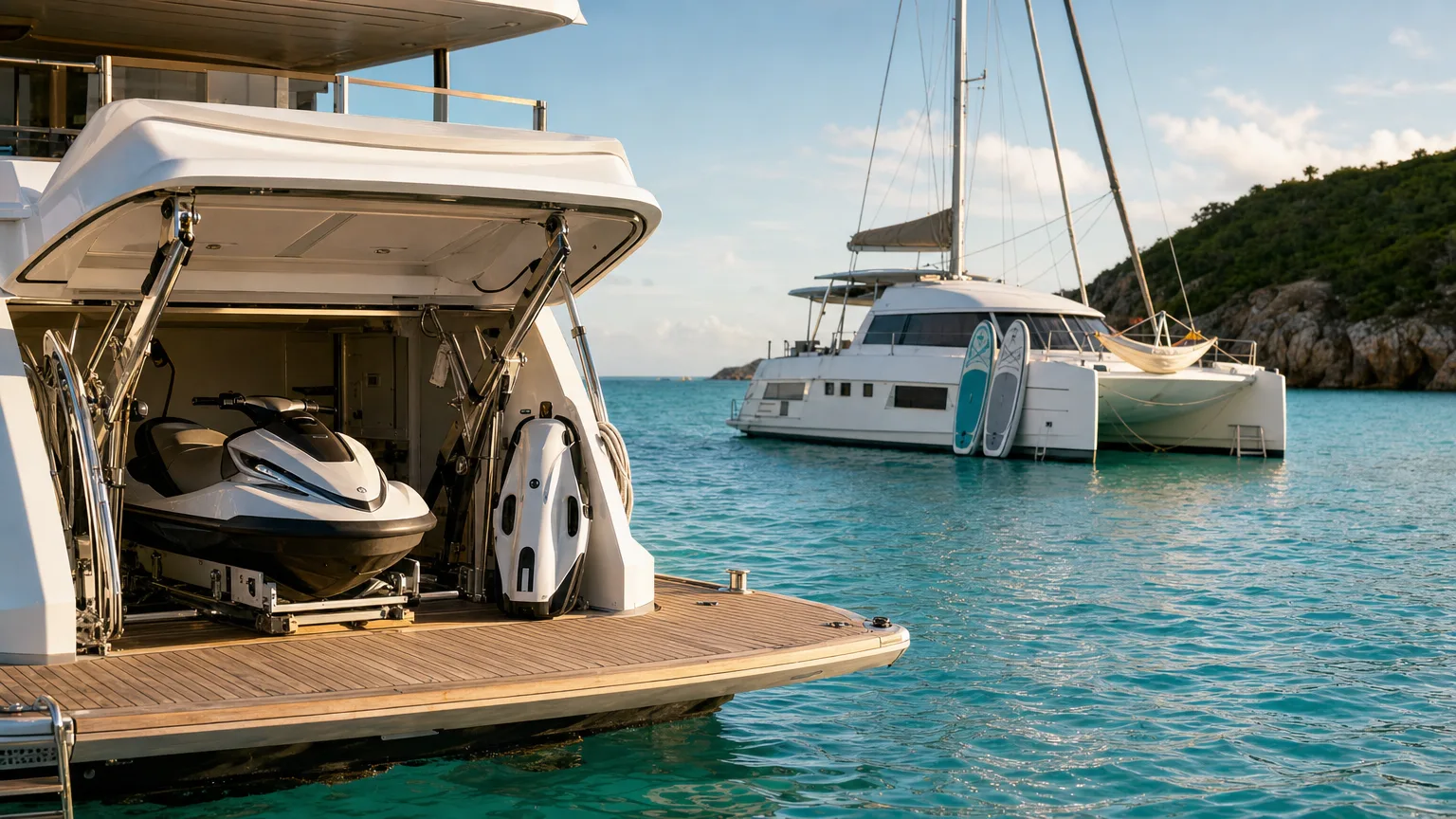
- A bigger crew, formal service, and a full water-toy garage
- The scale and presence of a 100ft+ superyacht
Still deciding? Our Caribbean catamaran charter guide and the breakdown of how to choose the right yacht size for your group both go deeper on matching the boat to your itinerary.
How Does Chartering Compare to Yacht Ownership?
Chartering costs a small fraction of ownership for anyone who spends fewer than 8–10 weeks a year on the water. The 10% rule is the industry’s rule of thumb: annual ownership costs (crew, insurance, berth, maintenance, fuel) run roughly 10% of a yacht’s purchase price (Boat International, 2025). A $12 million, 100ft motor yacht costs about $1.2 million a year to keep.
Even chartering two full weeks every year costs a fraction of that. An entry catamaran at $30K/week runs about $60K all-in for two weeks of use; owning a comparable boat runs hundreds of thousands annually. You also get variety: a different yacht, hull type, and destination every trip. For the full breakdown, see yacht charter vs. ownership cost.
Recommendations by Budget and Group Size
First-time charterers should match the boat type to their group and itinerary before chasing length. The per-person economics improve dramatically with fuller cabins, and a catamaran fills cabins at far shorter lengths.
For Groups of 4–8 (Couples or Small Families)
- Start with a $30K catamaran. A 55ft cat with 4 cabins is purpose-built for this group, more space than an older motor yacht twice the price to operate, and all-inclusive so budgeting is simple.
- Pick the Bahamas if you want beaches and sandbars. A catamaran’s shallow draft opens anchorages a deep-keeled motor yacht can’t reach.
For Groups of 8–12 (Extended Family or Corporate)
- The $50K catamaran tier is the best per-person value: five cabins near $715/person/day beats most luxury resort pricing for the same group.
- Choose a motor yacht if you’ll cover distance. Island-hopping across the BVI is easy on either hull; longer Caribbean passages favor a motor yacht’s speed and range.
- Ask what’s on offer instead of assuming a season discount. Seven catamarans in ten publish the same rate in low season as in high, and among the ones that do move, the typical cut is under 7%. The real shoulder-season saving is the promotional offer a yacht runs for a few weeks at a time, and those you have to ask about.
For the $100K+ Tier
- Decide the experience first. An 80ft catamaran maximizes space and value; a 116ft motor yacht maximizes amenities and presence. They cost similar headline rates but feel like different vacations.
- Budget the real number on motor yachts. Add 50–55% for APA and gratuity before you compare to an all-inclusive catamaran.
- Work with a specialist broker. At this tier, boats vary wildly. A broker who knows the fleet can match your group precisely, start a yacht search at Vital Charters.
Data Appendix: Full Tier Comparison by Hull Type
| Feature | $30K/Week | $50K/Week | $100K/Week |
|---|---|---|---|
| Catamaran length | 55 ft | 59–67 ft | 77–80 ft |
| Motor yacht length | 45–70 ft | 80–88 ft | 105–120 ft |
| Catamaran guests / cabins | 8 / 4 | 9–10 / 5 | 8–10 / 4–5 |
| Motor yacht guests / cabins | 6 / 3 | 8 / 4 | 10 / 5 |
| Catamaran pricing | All-inclusive | All-inclusive | All-inclusive |
| Motor yacht pricing | Plus expenses | Plus expenses | Plus expenses |
| Catamaran real all-in | ~$30K | ~$50K–$55K | ~$100K |
| Motor yacht real all-in | ~$45K–$46.5K | ~$75K–$77.5K | ~$150K–$155K |
| Catamaran example | High 5 | Nehalennia | Odyssey |
| Motor yacht example | Caprice | Indy | R&R |
One caveat on the left-hand column: motor yachts barely exist at the $30K tier. Only 11 of the 174 in this analysis measure under 65 ft, so a $30,000 budget is in practice a catamaran budget.
Citation format:
Vital Charters. “Superyacht Charter Cost by Size: $30K vs. $50K vs. $100K/Week.” Vital Charters Blog, updated September 2026.
See Real Yachts in Your Budget
Enter your price point and see real boats, not ranges. Plug $30K, $50K, $100K, or any budget in between, into the yacht search on our homepage, filter by catamaran or motor yacht, and see real crewed yachts available at that rate, with honest all-in pricing.
Frequently Asked Questions
Is a catamaran cheaper to charter than a motor yacht?
For the same number of guests, usually yes. To sleep 8 guests in 4 cabins, the median catamaran lists at $33,000 a week while the median motor yacht lists at $60,000 (Vital Charters rate analysis, 550 yachts, September 2026). Catamarans also charter all-inclusive 88% of the time, so the rate is close to your real cost, with no APA stacked on top.
Does a catamaran really have more space than a motor yacht of the same length?
Yes. In the 45-55 ft band, catamarans carry a median 8 guests across 4 cabins; the few motor yachts that short carry 6 guests across 3 (Vital Charters rate analysis, September 2026). Reaching a 4-cabin, 8-berth layout takes a catamaran a median 56 ft and a motor yacht 94 ft, so the catamaran’s wide living deck does the work of 38 extra feet of hull.
How much does it cost to charter a yacht for a week?
A 50-54 ft catamaran lists at a median $27,000 a week in high season, with a quarter of them at $24,000 or less; a 120 ft-plus motor yacht lists at a median $138,000 and lands nearer $207,000 once APA and gratuity are added (Vital Charters rate analysis, September 2026). On all-inclusive catamarans the rate is close to your total; on plus-expenses motor yachts, add 50–55% for APA and crew gratuity.
What is the 10% rule for yachts?
The 10% rule estimates that annual yacht ownership costs (crew, insurance, berth, maintenance, fuel) total roughly 10% of the yacht’s purchase price (Boat International, 2025). A $10 million yacht costs about $1 million a year to operate. For superyachts over 150ft, the figure can climb to 15%.
Why do motor yachts cost more to run than catamarans?
Motor yachts carry larger engines and burn far more fuel, so where a listing states an APA it runs a median 35% of the base rate, against 30% on the minority of catamarans that charter plus-expenses (Vital Charters rate analysis, September 2026). Most catamarans carry no APA at all. Motor yachts also crew up more, 8–12 hands on a 100 ft-plus motor yacht against 3–6 on a comparable-capacity catamaran, which raises the gratuity line too.
Can I cite this charter cost data?
Yes. Please cite as: Vital Charters, “Superyacht Charter Cost by Size: $30K vs. $50K vs. $100K/Week,” Vital Charters Blog, updated September 2026. Link to this page. Data is drawn from our analysis of 550 crewed-yacht listings holding a bookable 2026-27 Caribbean or Bahamas rate.
Tell us your budget: we’ll show you exactly what it buys.
Share your group size, dates, and weekly budget and we’ll send real crewed-yacht options across the $30K, $50K, and $100K tiers, with honest all-in pricing.