
BVI vs. Bahamas vs. St. Martin Charter Comparison (2026)
Compare BVI, Bahamas, St. Martin and the Grenadines for your next charter. A crewed catamaran week for eight lands at $32,400 to $41,540 depending on where you sail it.
Last Updated: September 7, 2026
The global yacht charter market hit $8.35 billion in 2024, growing at 5.2% annually (Grand View Research, 2024). With four genuinely distinct Caribbean crewed charter destinations competing for your week off, picking the right one isn’t just about turquoise water and trade winds. It’s about matching the destination to the way you actually want to spend your time.
The BVI, Bahamas, St. Martin, and the Grenadines all deliver warm water and reliable sailing. The weekly rate for a crewed catamaran barely separates them, $28,000 to $31,000 across all four (Vital Charters rate analysis, September 2026), but what you actually pay by the end of the week does, and so do sailing challenge, cultural depth, marine life and island variety. This guide breaks down all four so you can stop second-guessing and start booking.
BVI, Bahamas, St. Martin, and Grenadines Charter Comparison
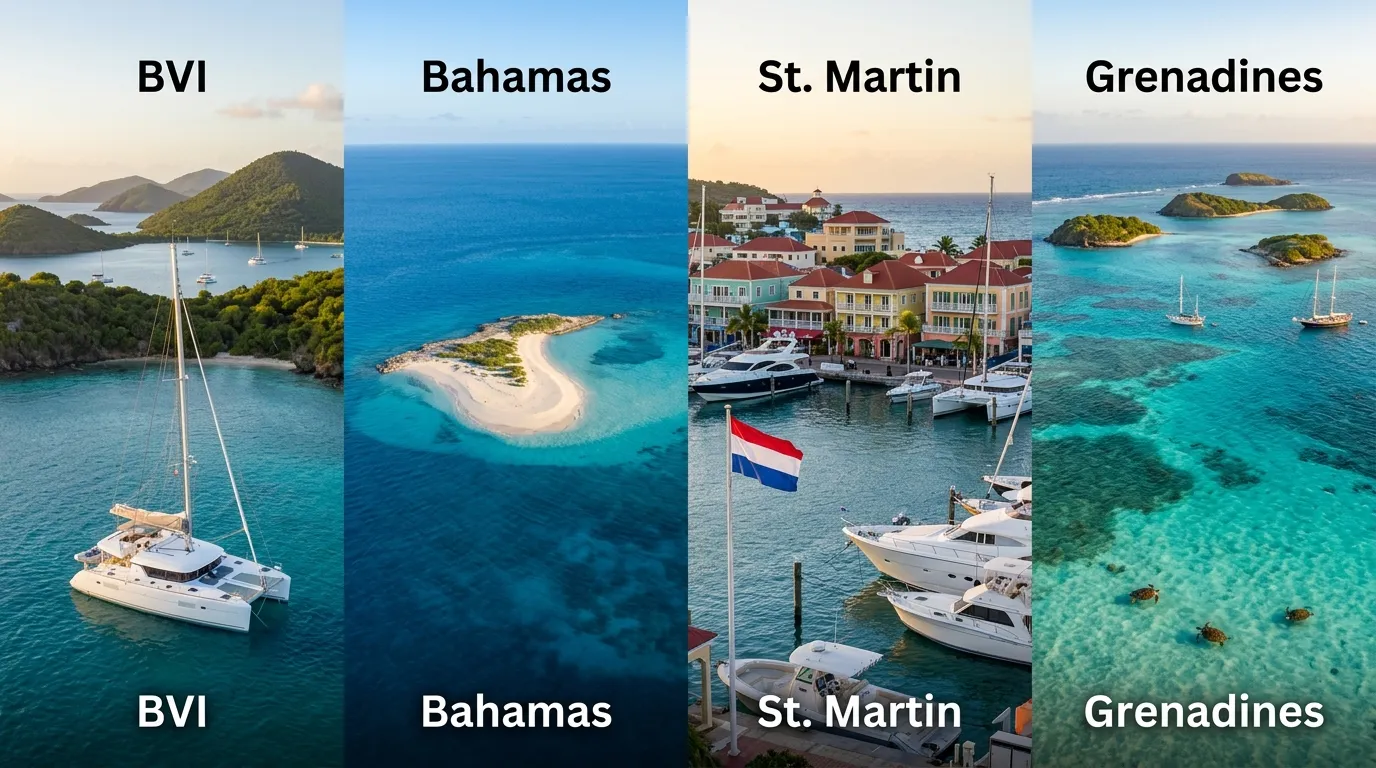
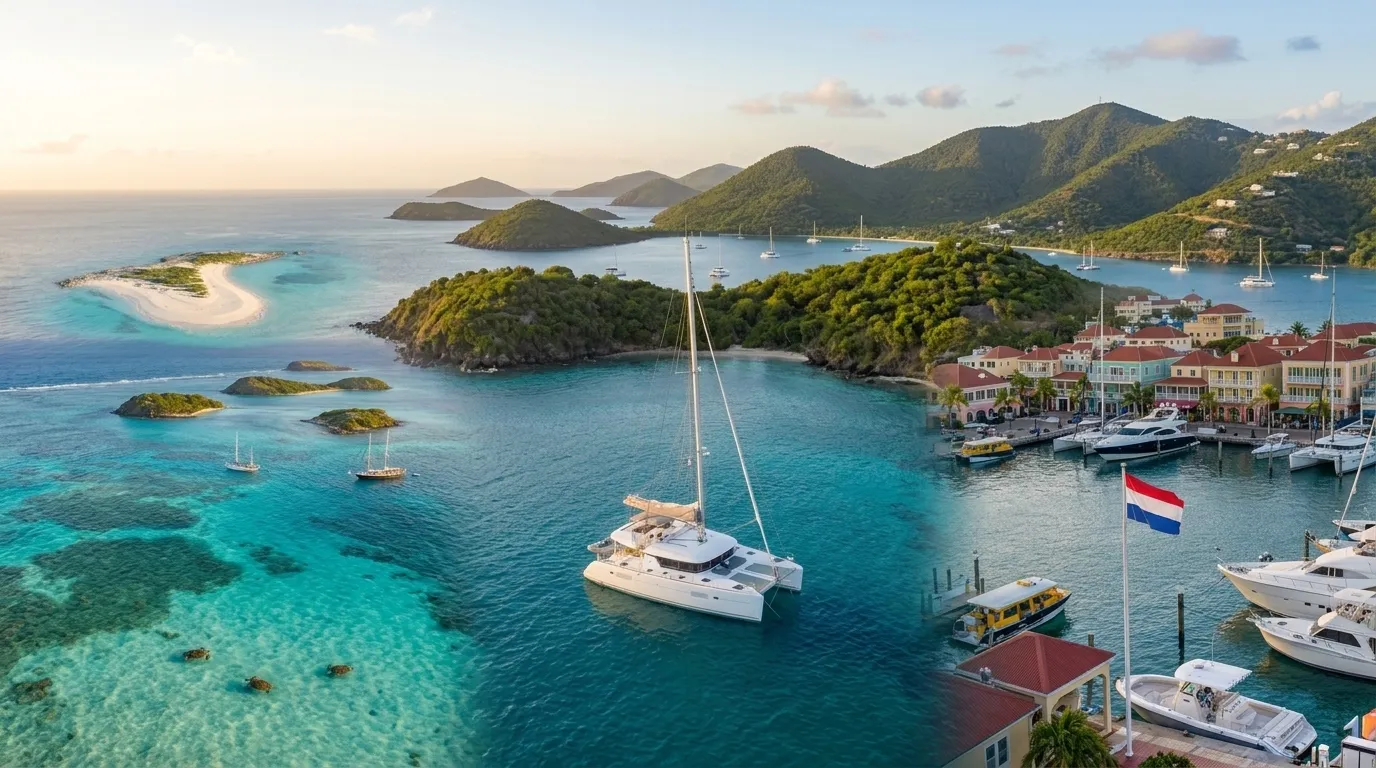
The Caribbean charter scene splits into four genuinely different experiences across the region’s top charter destinations, and understanding each destination’s core identity will save you from spending on the wrong trip. We can help you identify which destination fits the experience you are looking for. More than half the active Caribbean crewed fleet lists the BVI among its cruising grounds, 369 yachts of 668, and it is a visibly younger fleet than the regional average: 28% built in 2024 or later against 22% region-wide, on an average age of 7.7 years against 9.7 (Vital Charters rate analysis, September 2026). That concentration isn’t accidental: the BVI was built specifically around people who rent boats for a week. Of the four, the British Virgin Islands is the most charter-ready, which is why it anchors most first trips.
The BVI
The BVI packs 60+ islands and cays into a compact zone where no passage exceeds 15 nautical miles. It’s the most charter-optimized sailing ground on earth: purpose-built moorings, well-stocked provisioning bases, and a fleet that skews newer than any comparable destination. If you’re a first-time charterer, it’s the obvious starting point.
The Bahamas
The Bahamas is the opposite extreme. With 700 islands and 2,400 cays spread across 5,358 square miles, it’s built for sailors who want space, silence, and genuine remoteness (Government of The Bahamas). It welcomed a record 11.22 million visitors in 2024 (Bahamas Tourism), but most were cruise passengers. The out-island anchorages? You’ll sometimes be the only boat for miles.
St. Martin
St. Martin sits squarely in the middle. Over 20,000 yachts visit annually, and the island’s yachting sector contributes $165 million to the local economy, 11.1% of total GDP (Economic Impact Study of St. Maarten’s Yachting Sector). What sets it apart isn’t scale: it’s the French-Dutch dual identity and its role as a hub for Anguilla, St. Barths, and Saba.
The Grenadines
St. Vincent and the Grenadines captures 36% of all yacht visitors to the Eastern Caribbean, more than St. Lucia, Grenada, or Antigua (St Vincent Times, 2025). The archipelago’s 32 islands and cays stretch south through some of the most pristine marine environments in the Caribbean, anchored by the Tobago Cays Marine Park, a 50 sq km protected lagoon that draws roughly 8,000 vessels per year (Tobago Cays Marine Park). SVG recorded 120,599 stay-over visitors in 2025, a 17.4% jump driven by improved air access through the new Argyle International Airport (Searchlight, Mar 2026). If you’ve done the BVI and want something wilder, the Grenadines are where experienced charterers go next. Explore our Grenadines yacht charter routes for detailed itineraries.
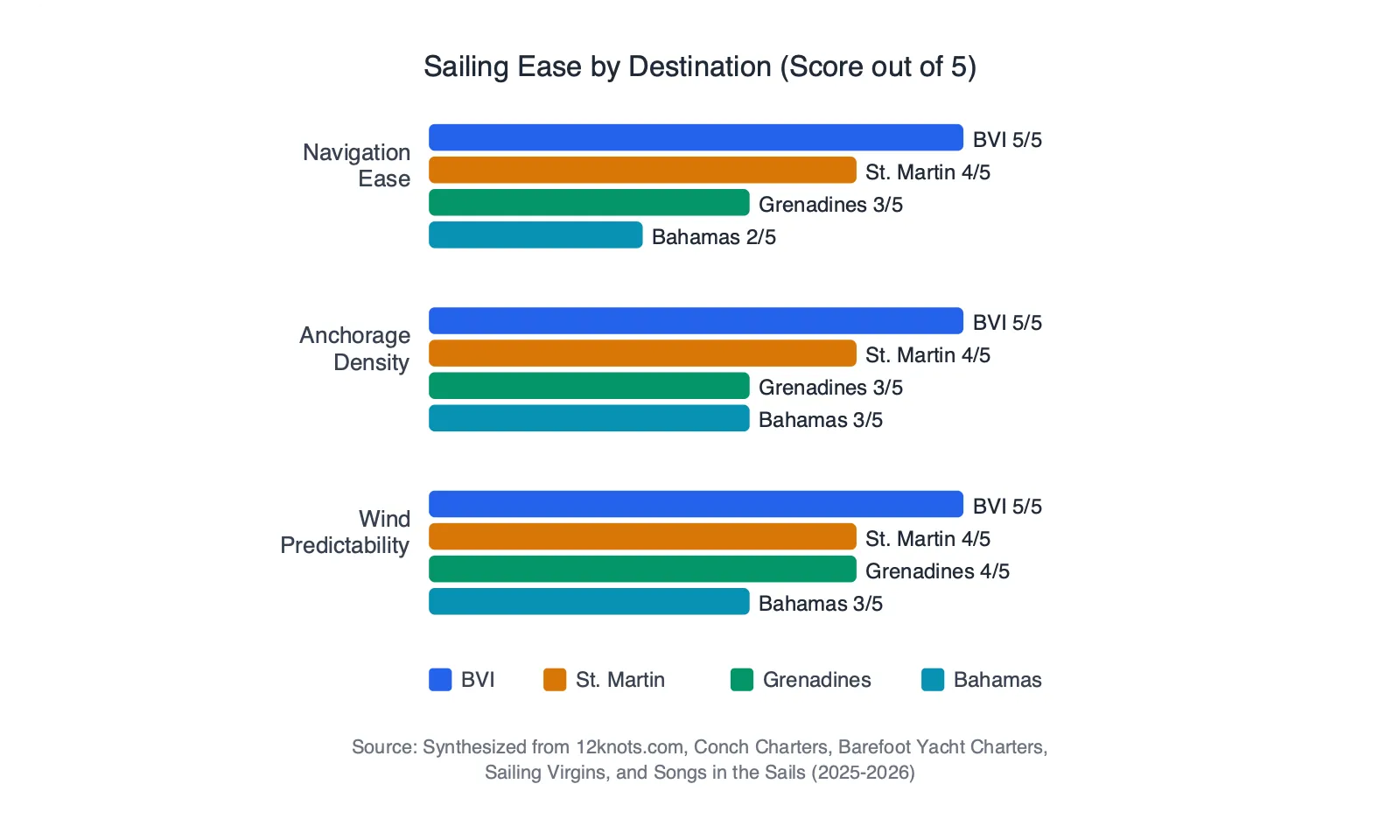
Sailing Conditions: Which Destination Matches Your Skill Level?
Trade winds blow a consistent 15-25 knots across the Eastern Caribbean from November through May. On a crewed charter none of that is your problem to solve, but it still shapes your day, because passage length decides how much of it you spend under way:
- BVI, the gentlest. No passage exceeds 15 nautical miles and navigation is line-of-sight, so most anchorages are reached in two to three hours. You are at anchor by noon with the afternoon for snorkeling.
- St. Martin, a little more open. Crossings of 8 to 15 nautical miles to Anguilla and St. Barths pick up some Atlantic swell, so you will feel the boat move on the way over. If you have done a BVI or USVI week, this is the natural next one.
- Grenadines, more exposed. Passages of 9 to 15 nautical miles run through open water rather than the BVI’s protected channels. Longer legs, emptier anchorages at the end of them.
- Bahamas, the most demanding. Exuma passages of 50 nautical miles or more cross open Atlantic water over shifting shallow banks that have to be read by eye. This is the week where the captain earns the fee, and it is the reason the Bahamas rewards a crew who know the banks.
Our observation: The Grenadines sit at 12.2-13.2°N latitude, below the traditional hurricane belt. That’s a meaningful advantage for shoulder-season bookings. We’ve helped clients book May and June Grenadines charters with significantly lower hurricane anxiety than equivalent BVI or Bahamas trips at the same time of year.
One rule applies everywhere: don’t sail during hurricane season. June 1 through November 30, peaking September-October (NOAA). Book December through April for the most reliable wind, lowest risk, and best underwater visibility.
View data table
| Criteria | BVI | St. Martin | Grenadines | Bahamas |
|---|---|---|---|---|
| Navigation Ease | 5/5 | 4/5 | 3/5 | 2/5 |
| Anchorage Density | 5/5 | 4/5 | 3/5 | 3/5 |
| Wind Predictability | 5/5 | 4/5 | 4/5 | 3/5 |
Charter Costs: What’s Your Budget Reality?
The Bahamas sits highest not because it offers more luxury but because longer passages, fewer provisioning stops, and higher fuel costs push operators to price accordingly. Crewed catamaran rates tell a different story, and a much flatter one than most comparisons admit. For a 50 to 59 ft all-inclusive catamaran the median week is $31,000 in the BVI, $31,000 in the Bahamas, $31,000 in St. Martin and $28,000 in the Grenadines (Vital Charters rate analysis, September 2026). The destination is not what sets that number. For a full breakdown of what’s included at each price tier, see our charter costs guide.
| Destination | Median week, 50-59 ft all-inclusive catamaran | Government charges that reach you | Crew gratuity, 15-20% | Landed cost for the week | Per person, per night |
|---|---|---|---|---|---|
| Grenadines | $28,000 | About $200 in Tobago Cays park fees across three park days | $4,200-$5,600 | $32,400-$33,800 | ~$591 |
| BVI | $31,000 | None on top: the cruising permit and arrival levy sit inside the rate | $4,650-$6,200 | $35,650-$37,200 | ~$650 |
| St. Martin | $31,000 | None per guest: the French islands charge the yacht, not you | $4,650-$6,200 | $35,650-$37,200 | ~$650 |
| Bahamas | $31,000 | $4,340: 10% VAT plus a 4% charter tax on the fee | $4,650-$6,200 | $39,990-$41,540 | ~$728 |
Eight guests, seven nights, high season 2026-27. Rates are medians for the 50 to 59 ft all-inclusive crewed catamaran Vital Charters rate analysis, September 2026); government charges from the gazetted schedules, verified September 2026. All-inclusive terms carry no APA, so nothing is reconciled at the end of the week; on a plus-expenses yacht an APA of 30 to 35% is added up front and whatever you do not spend comes back to you.
Here’s what makes those numbers feel less alarming: the rate covers lodging, transport, and activities in one daily rate, no resort hotel, no rental car, no tour bookings needed. What other vacation format bundles all three?
Our observation: May departures buy a quieter anchorage far more reliably than a lower rate. Of 522 Caribbean yachts publishing both a high and a low season price, 280 quote the identical number in both (Vital Charters rate analysis, September 2026), so a shoulder discount arrives as a promotional special rather than a lower rate card, which is exactly why you ask about it rather than budget around it. But the BVI and St. Martin hold excellent trade winds reliably through mid-June, making them the strongest shoulder-season picks. The Grenadines’ position below the hurricane belt makes their shoulder season even more appealing.
St. Martin’s reputation as the cheaper Eastern Caribbean base does not survive the rate data: the same 50 to 59 ft all-inclusive catamaran medians $31,000 there and $31,000 in the BVI (Vital Charters rate analysis, September 2026). Where St. Martin genuinely saves you money is ashore, on a French side that eats and drinks for well under BVI prices. The Grenadines do undercut everyone afloat, by about $3,000 on the same boat, and land cheapest of the four because the only government charge that reaches a guest there is the Tobago Cays park fee. The trade is choice: 116 priced crewed catamarans against 282 in the BVI. Planning to budget for your first charter? St. Martin or the Grenadines give you the most sailing for your money.
Activities, Culture, and Food: Beyond the Sailing
St. Martin’s average stayover visitor spends $149 per day on leisure, food, and culture, with 80% arriving specifically for those experiences (Government of Sint Maarten, 2024). Great sailing gets you to the anchorage. What you do once you drop the hook determines whether the trip is memorable or merely scenic. So what does your ideal afternoon actually look like?
Bahamas: The marine biology winner. Swimming with wild pigs at Pig Beach, snorkeling above nurse sharks at Compass Cay, and exploring some of the deepest blue holes in the world. These are genuinely singular experiences. What the Bahamas doesn’t win is food. Remote Bahamian cays mean provisioning your own meals or eating at the occasional beach bar. The isolation is the point.
BVI: Built on legendary beach bars. The Soggy Dollar in White Bay (inventor of the original Painkiller cocktail), Foxy’s on Jost Van Dyke, the Bitter End Yacht Club at North Sound. These stops are woven into Caribbean sailing culture. Snorkeling is exceptional too: the Baths at Virgin Gorda and the RMS Rhone shipwreck are world-class. For a deeper look, check our BVI crewed yacht charter guide. Dining beyond the beach-bar scene is limited, and you won’t find much cultural depth away from the water.
St. Martin: The outlier: in the best way. The French side has restaurants that could hold their own in a Paris arrondissement. The Dutch side has casinos, nightlife, and Maho Beach, where jumbo jets land about 50 feet over sunbathers’ heads. Thirty-seven beaches, two distinct cultures in one 37-square-mile island, plus proximity to St. Barths (15 nm), Anguilla (8 nm), and Saba (25 nm). How many charter destinations offer a Michelin-caliber dinner two miles from your anchorage?
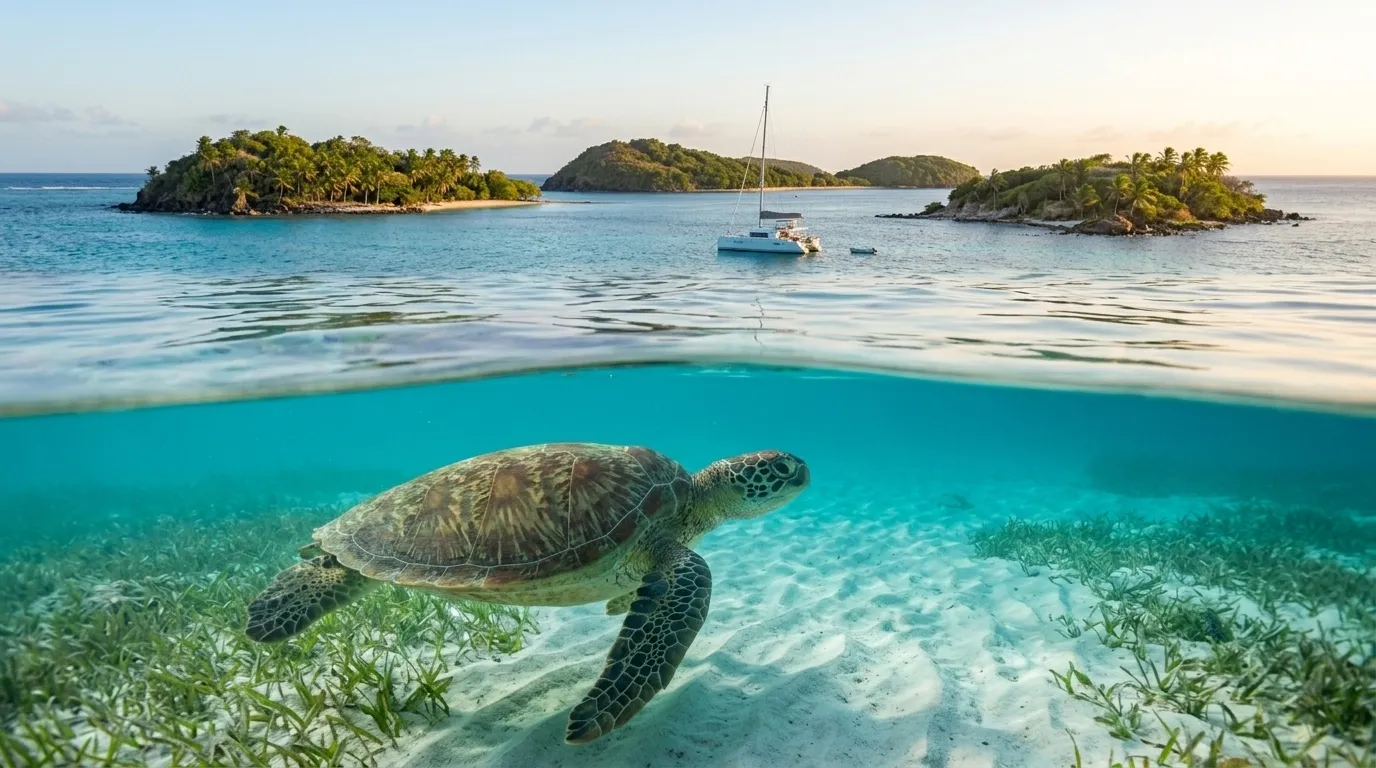
Grenadines: The nature-first pick. Tobago Cays Marine Park delivers virtually guaranteed sea turtle encounters, green and hawksbill turtles feed in waist-deep sea grass beds near Baradal island, protected by the 4 km Horseshoe Reef (Tobago Cays Marine Park). None of the other three destinations have anything equivalent: uninhabited islands, a protected marine park, and world-class snorkeling all accessible directly from anchorage. And there’s Mustique: 120 private villas, one hotel, paparazzi literally banned, with Basil’s Bar over the water at Britannia Bay as the one place visiting yachts can walk straight in. Petit Tabac in the Tobago Cays was the filming location for Jack Sparrow’s marooned island in Pirates of the Caribbean.
Culturally, the Grenadines carry a distinct Garifuna heritage, an Afro-Caribbean tradition recognized by UNESCO as Intangible Cultural Heritage. Bequia, the largest Grenadine, blends Scottish, African, and Kalinago influences with one of the last legal aboriginal whaling communities in the world. The food scene ranges from casual beachfront fish fry on Mayreau to upscale dining on Mustique. It’s more authentic and less commercialized than any of the other three.
What most charter blogs miss: St. Martin’s dual-nation status is a practical provisioning advantage. The French side stocks better wine, cheese, and bread at European prices. The Dutch side processes customs clearance faster. You can rotate your anchorage schedule to capture the best of both, two vacation identities layered onto one island.
Scale and Island Variety: How Much Do You Want to Explore?
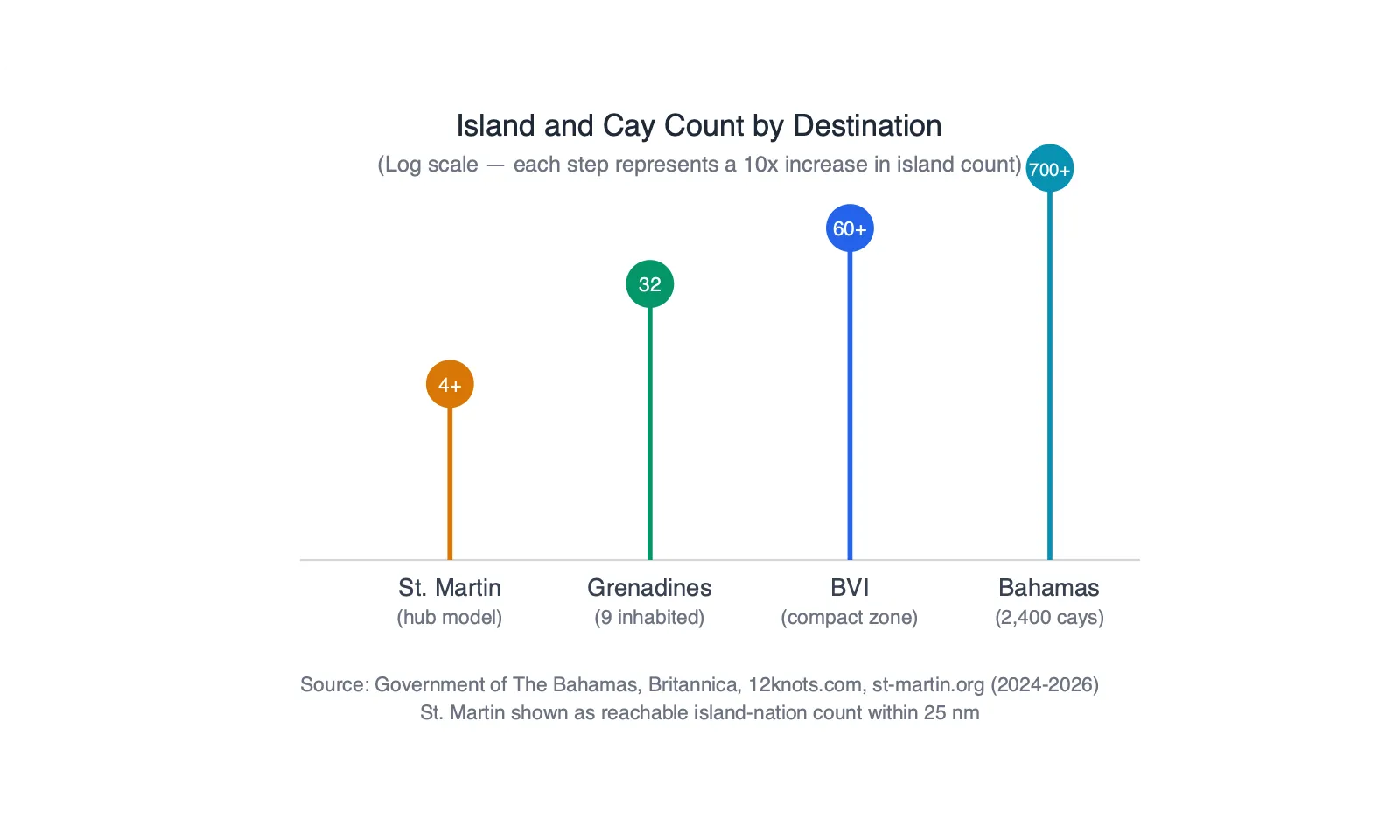
The Bahamas’ 700 islands and 2,400 cays span 5,358 square miles (Government of The Bahamas): more cruising ground than most sailors will cover in a lifetime. The Exumas alone, a 120-mile chain south of Nassau, keep repeat charterers coming back year after year. The downside: scale cuts both ways. Longer passages, more open Atlantic exposure, and fewer services when something breaks mid-trip.
The BVI packs 60+ islands into a compact area where no passage takes more than a few hours. In a single week, you’ll visit more distinct anchorages than most destinations offer in total. The tradeoff: popular spots like the Baths and Norman Island will have company in peak season. Why does a compact sailing ground outperform a vast one for most charterers? Because in a week, time is the constraint: not miles.
St. Martin’s model is different again. The island itself is small, but it functions as a regional hub. Anguilla, St. Barths, and Saba are all reachable in under 2 hours. Each carries its own character: Anguilla’s understated luxury, St. Barths’ French sophistication, Saba’s volcanic drama. A week out of St. Martin can feel like visiting four countries without repeating a beach.
The Grenadines thread a compelling middle ground. SVG’s 32 islands and cays (9 inhabited) form a north-south chain that’s perfect for a one-way week of island-hopping (Britannica). Start in St. Vincent, work south through Bequia, Mustique, Canouan, and the Tobago Cays, and end at Union Island, each stop genuinely different from the last. Mayreau has roughly 300 residents and no cars. Petit St. Vincent communicates by flag system. It’s the closest thing to undiscovered Caribbean you’ll find in 2026.
View data table
| Destination | Islands/Cays | Sailing Area | Model |
|---|---|---|---|
| St. Martin | 4+ nearby nations | Hub with Anguilla, St. Barths, Saba | Hub-and-spoke |
| Grenadines | 32 islands (9 inhabited) | North-south chain | Linear island-hop |
| BVI | 60+ islands and cays | Compact zone, <15 nm passages | Dense cluster |
| Bahamas | 700+ islands, 2,400 cays | 5,358 sq mi spread | Vast archipelago |
SVG recorded 120,599 stay-over visitors in 2025: a 17.4% jump over the previous year (Searchlight, Mar 2026). Growth driven by the new Argyle International Airport, enhanced airline routes, and a wave of new hotel inventory. The Grenadines are getting easier to reach, but the islands themselves haven’t changed, and that’s precisely the appeal.
Who Should Choose Each Destination?
Each destination serves a different type of charterer. The BVI’s 282 priced crewed catamarans and purpose-built infrastructure make it the default for newcomers, while the Bahamas’ 700-island spread rewards experienced navigators with genuine solitude. St. Martin’s French-Dutch cultural blend and competitive pricing attract foodies and value-conscious sailors. The Grenadines, with 36% of Eastern Caribbean yacht traffic and a position below the hurricane belt, increasingly draw repeat charterers who’ve outgrown the BVI’s familiar anchorages. The BVI welcomed 1,092,139 total visitors in 2024, up 9.8% year-over-year (BVI Government via Virgin Islands Daily News, Jan 2025): proof that decades of refinement pay off. But high fleet share doesn’t make it right for everyone. So which type of sailor are you?
| BVI | St. Martin | Grenadines | Bahamas | |
|---|---|---|---|---|
| Landed cost/week, 8 guests | $35,650-$37,200 | $35,650-$37,200 | $32,400-$33,800 | $39,990-$41,540 |
| Skill level | Beginner-Advanced | Intermediate | Intermediate | Experienced |
| Max passage (nm) | 15 nm | 15 nm | 15 nm | 50+ nm |
| Island count | 60+ | 4 nearby nations | 32 (9 inhabited) | 700+, 2,400 cays |
| Priced crewed catamarans | 282 | 134 | 116 | 45 |
| Best for | First-timers, families | Culture, value | Nature, privacy | Adventure, solitude |
| Top draw | Beach bars, snorkeling | French-Dutch food, hub | Tobago Cays, Mustique | Remote exploration |
| Hurricane belt | Inside (18.4°N) | Inside (18.0°N) | Below (12.2-13.2°N) | Above (24-27°N) |
Choose the BVI if: You’re chartering for the first time or sailing with young children. You want short passages, consistent winds, and well-marked routes. The social scene is half the draw: Soggy Dollar, Foxy’s, and the Bitter End are bucket-list stops. You’d rather sail confidently than push your limits.
Choose the Bahamas if: You’ve got at least 2-3 seasons of bluewater sailing under your belt. Open-water passages and careful navigation challenge you in a good way. Swimming with wild pigs, exploring remote blue holes, and fishing off uninhabited cays appeals more than a restaurant scene.
Choose St. Martin if: Budget is a genuine factor and you want the best boat for your money. Food, wine, and culture are non-negotiable parts of a great vacation. You want one base with multiple distinct destinations reachable in a day sail.
Choose the Grenadines if: You’ve already done the BVI and want wilder sailing without extreme ocean passages. Nature, marine life, and untouched islands matter more to you than nightlife or restaurant variety. You’re drawn to Mustique’s exclusivity, Tobago Cays’ turtle snorkeling, or Mayreau’s 300-person village where there aren’t any cars. Interested? Decide whether a catamaran or motor yacht suits your Grenadines itinerary.
Our observation: Some of the best Caribbean itineraries combine two destinations across back-to-back charters. We’ve helped clients pair BVI and St. Martin in January, or Grenadines and the BVI in February. The contrast, BVI’s sailing efficiency vs. the Grenadines’ raw beauty, covers both bases without forcing one destination to do everything. Charter operators see these pairings regularly in peak season.
Which Caribbean Charter Should You Book?
Four destinations, four genuinely different identities. The BVI delivers the world’s most refined charter experience, consistent, concentrated, and built for maximum sailing with minimum stress. The Bahamas offers raw scale, genuine remoteness, and passages that demand real skill. St. Martin threads the needle with cultural depth, a hub-and-spoke island network, and competitive pricing. The Grenadines are the rising pick: unspoiled marine environments, Mustique’s exclusivity, and the lowest entry price in the comparison.
Key takeaways:
- First-timers and families: BVI: short passages, the largest crewed catamaran fleet at 282 priced listings, consistent trade winds, landing at $35,650-$37,200 for the week
- Experienced sailors seeking adventure: Bahamas: 700+ islands, open-water passages, true isolation, landing at $39,990-$41,540 once the 14% tax is added
- Value seekers and culture lovers: St. Martin: French-Dutch culture and a regional hub, landing at $35,650-$37,200, with the real saving ashore rather than on the rate
- Nature purists and repeat charterers: Grenadines: Tobago Cays turtle snorkeling, Mustique exclusivity, below the hurricane belt, and the cheapest landed week of the four at $32,400-$33,800
The charter market’s 5.2% annual growth signals one thing clearly: more people are discovering that a week aboard beats any resort. The only question is where you’ll drop anchor first. Ready to start planning? Compare crewed yachts across all three or get in touch and we’ll help you choose.
Frequently Asked Questions
What’s the best Caribbean charter destination for beginners?
The BVI is the clear choice for first-time charterers. Trade winds blow a consistent 15-25 knots between November and May, no passage exceeds 15 nautical miles, and 369 active crewed yachts list the BVI among their cruising grounds, 28% of them built in 2024 or later. That fleet concentration means provisioning bases, mooring fields, and emergency support are always within a short sail. It’s also the most predictable budget option for families: short passages keep everyone comfortable, and the Baths at Virgin Gorda, Norman Island Caves, and snorkeling at the Indians deliver kid-friendly adventure without demanding advanced sailing skill. Planning your first trip? Our yacht charter planning guide walks through every step.
When is the best time to charter in the Caribbean?
December through April is peak season across all four destinations, the most reliable trade winds and lowest hurricane risk. Hurricane season runs June 1 through November 30, peaking in September-October (NOAA). May and early June work well as shoulder months: quieter anchorages and far better availability, though the rate itself usually holds, especially in the BVI, St. Martin, and the Grenadines.
How much does a Caribbean yacht charter cost per person per day?
Peak season (December through April) is when availability tightens across all four destinations, though on most hulls the published rate does not change: 280 of 522 Caribbean yachts quote the same week in high and low season (Vital Charters rate analysis, September 2026). The Grenadines’ position below the hurricane belt makes their shoulder season particularly attractive, since the weather risk that drives prices down in other destinations is significantly lower at 12.2-13.2°N latitude.
Is the BVI or Bahamas better for families?
The BVI is stronger for most families. Short passages mean nobody arrives exhausted, and the Baths at Virgin Gorda, Norman Island Caves, and snorkeling at the Indians deliver kid-friendly adventure without demanding advanced sailing. The Bahamas suits families with older teenagers who are ready for longer open-water passages and want swimming-with-pigs bragging rights.
What makes the Grenadines different from the BVI?
The Grenadines trade the BVI’s polished charter infrastructure for raw natural beauty. You won’t find beach bars every mile, but you will find Tobago Cays Marine Park, five uninhabited islands with guaranteed turtle snorkeling, protected by the 4 km Horseshoe Reef (Tobago Cays Marine Park). Passages between islands run 9-15 nautical miles through open water, requiring intermediate sailing ability (RYA Day Skipper or ASA 104). The Grenadines sit below the hurricane belt at 12.2-13.2°N latitude, making shoulder-season voyages significantly lower risk than equivalent trips in the BVI or Bahamas. It’s the destination experienced Caribbean charterers graduate to, 36% of all yacht visitors to the Eastern Caribbean now choose SVG over St. Lucia, Grenada, or Antigua.
Do I need sailing experience to charter in St. Martin?
No. On a crewed charter the captain runs the boat, so no certification, no experience and no watch-keeping is asked of you. That is worth saying plainly for St. Martin in particular, because the crossings to Anguilla and St. Barths cross open Atlantic swell that rewards someone who has done them before, and your captain has. The island’s 11 marinas give them unusual flexibility when the forecast moves.
Tell us your style: we’ll pick the right destination.
Share your group size, dates, and what you want most from the week (anchorages, nightlife, or wide-open water) and we’ll match you to a crewed yacht in the destination that fits.